Rotten: Why 'Better for You' Must Not Be Boring
Rotten: Why 'Better for You' Must Not Be Boring
Most "better for you" brands follow the same unwritten rule: if your product is healthier, your brand should look the part. Clean lines, muted tones, wellness signals everywhere. Rotten, the low-sugar candy brand built on prebiotic fibre and a gloriously unsettling aesthetic, has other ideas. Founder and CEO Michael Fisher has made a challenger brand that tastes great, does good things for your gut, and looks like it absolutely should not be on the same shelf as the health food. Despite early disbelief and rejection from grocery buyers, Rotten is now one of the fastest growing brands in confectionery, earning nationwide distribution at a record pace. eatbigfish Strategy Director Jono Wylie sat down with Fisher to find out how Rotten is rewriting the rules of the better-for-you category, one gummy at a time.
.jpg)
What category behaviour is Rotten challenging? Are there any mindset assumptions, or category assumptions that you're fighting against?
I think there are two main assumptions that we're fighting; one of them is around product, and the other is around brand.
On the product side, we challenge the notion that you need a bunch of terrible ingredients to make a really good tasting candy or product.
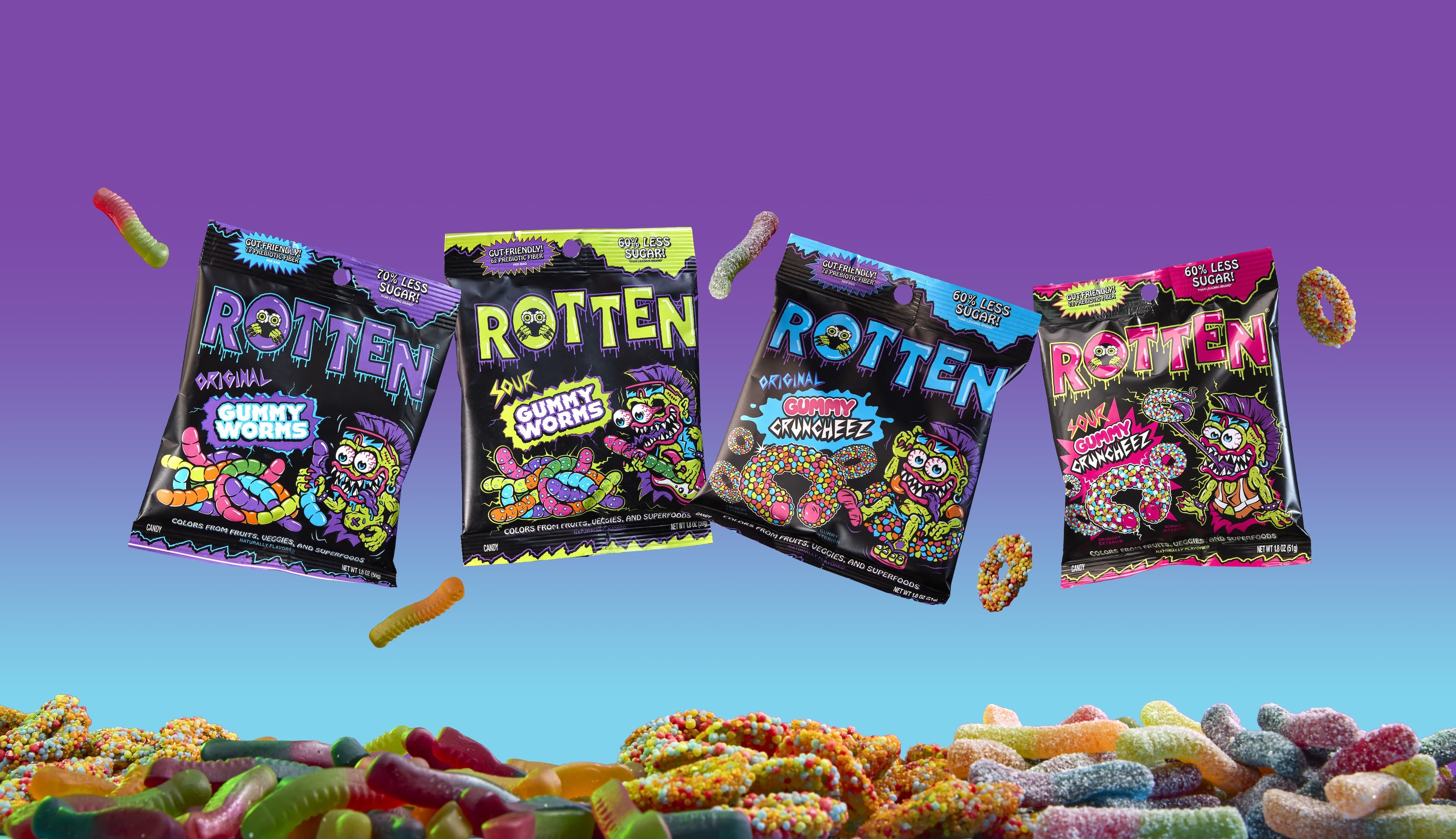
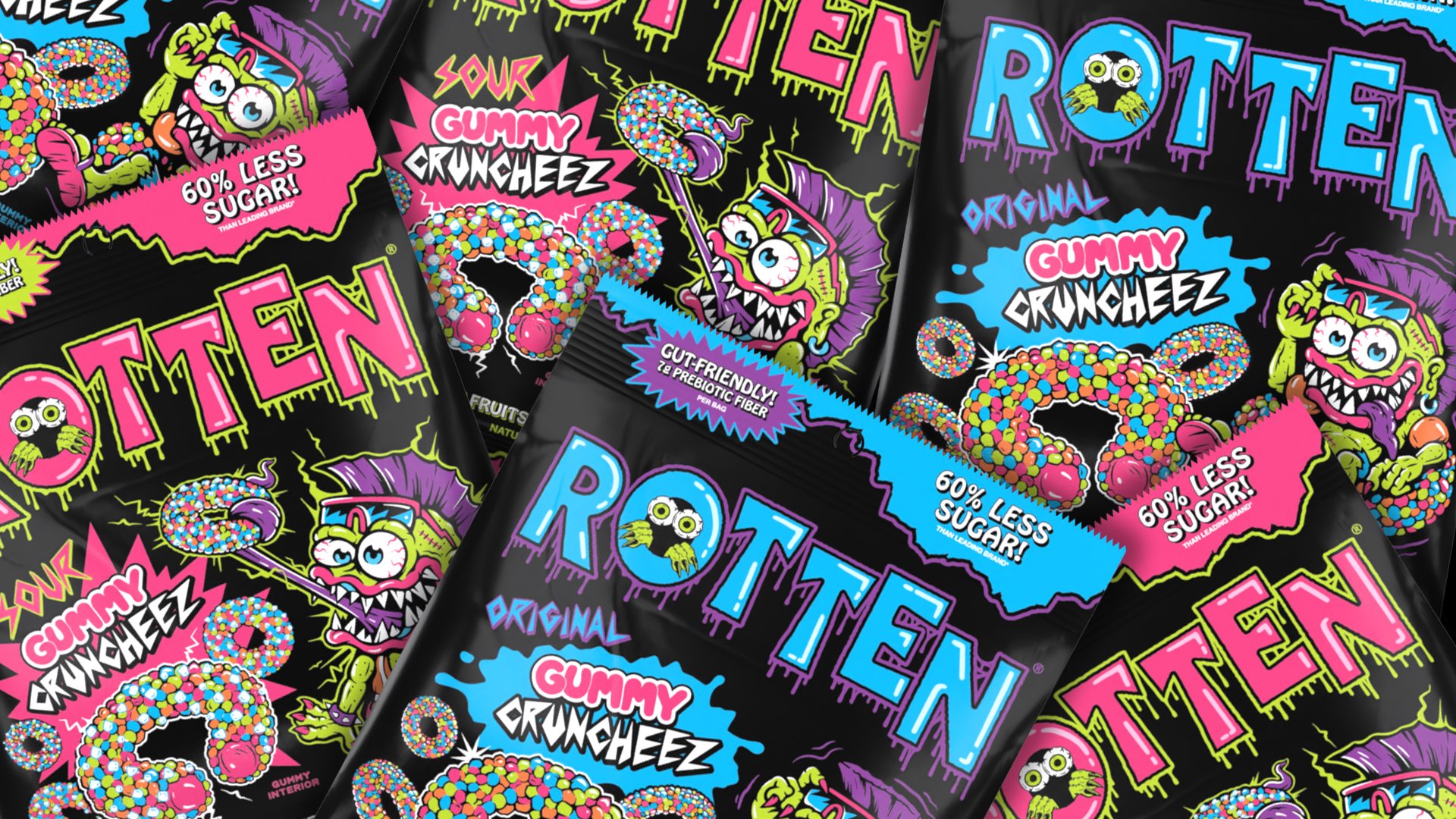
On the brand side, what we're really challenging is the idea that if you are making a “better for you” product with healthier ingredients, your brand needs to look healthy. We very intentionally designed a brand to look the exact opposite of what someone's expectations might be based on the product.
We've heard it said by people who study innovation that if your innovation is completely unexpected, the market won't know what to do with it. A common rule is 80% familiar and 20% fresh. I don’t want to assume, but it feels like you break that rule a bit. First, do you agree with that assessment? And second, what challenges do you face by being so different?
It’s a great point, and something I think about a lot when we’re designing anything, whether it’s the product or the packaging. I don’t know if I have a firm rule in my head like 80-20, but it’s about how we can feel familiar to people.
Because our brand is new to them, we also need to ensure that the product we’re making is different from what’s already out there, so that part will naturally feel new.
So what are the ways we can still make it feel familiar? Some examples: the flavours in our candy are classic candy flavours for the gummy kid category. We are not introducing novel, foodie type flavours. Ours are blueberry, raspberry, cherry, strawberry, orange, lime, your classics.
We’ve also focused on product formats people are familiar with. Everyone knows what a gummy worm is, and our gummy crunchies are based on a familiar format, a crunchy outside with a gummy inside.
And then our brand is obviously new, but it’s built off many different references from the same kind of funny world. Every person I talk to says, “your brand reminds me exactly of X,” and while the references differ, they’re all similar and they’re all right. The brand was built off a host of cool historical references that we intentionally used to create a sense of nostalgia.
So just to clarify, you’re saying that while it might feel fresh and unexpected for the candy category in 2026, there’s actually a lot of familiarity buried underneath? Like a childhood memory of how candy is supposed to taste or how fun things are supposed to look?
Yeah, exactly. There are so many ways to find that balance between novel and familiar. You can also play with the idea that something is broadly familiar but feels novel within the candy category. That’s an interesting space to explore too.
We often say a brand for everyone is a brand for no one. Good challengers divide the world. Rotten definitely divides the world. You call out negative reviews and even call people “wimps,” which is hilarious. But I imagine you also divide buyers, people who don’t know where to place you in store. Can you talk about that?
I remember early on, there was a broker that an advisor connected us with. I was super excited about working with them. Then I sent them the product, they showed it to their team, and ultimately they passed.
They said that because we are a 'better for you' product, like others in the premium low-sugar space, we have that kind of price point, but our packaging looks like conventional candy. They said they would never work with us.
It was funny to me, because that’s the whole point. They had identified our reason to exist. Still, it sucks getting feedback like that.
I concluded that if we’re not getting responses like that, then what we’re doing probably isn’t very new or interesting. If everyone gets it and agrees immediately, it’s probably already been done.
We’ve also had retailers who still won’t stock us. One conservative retailer loved the product but said they couldn’t put a brand called “Rotten” on their shelves.
Have you noticed the opposite, that for every rejection, there’s deeper love from the people who do choose you? Is there higher velocity? What have you noticed from those people that do get it and do pick you up?
Yes, there is huge love for our brand, even before people try the product. Our brand is art and creativity forward, and we resonate deeply with that audience.
But the biggest thing is how memorable we are. We get so many reactions from people who have only seen us once, like someone spotting us in Denver Airport, and they remember us. How often do you see a brand like ours? It’s eye catching and memorable.
As an emerging challenger brand, we don’t have the budget to be everywhere constantly. So our packaging has to do a lot of the work. Whether people love us or hate us, at least they remember us.
We even quantified this. We ran a study on brand memorability and found that our brand is six times more memorable than the average brand in the US, according to Meta.
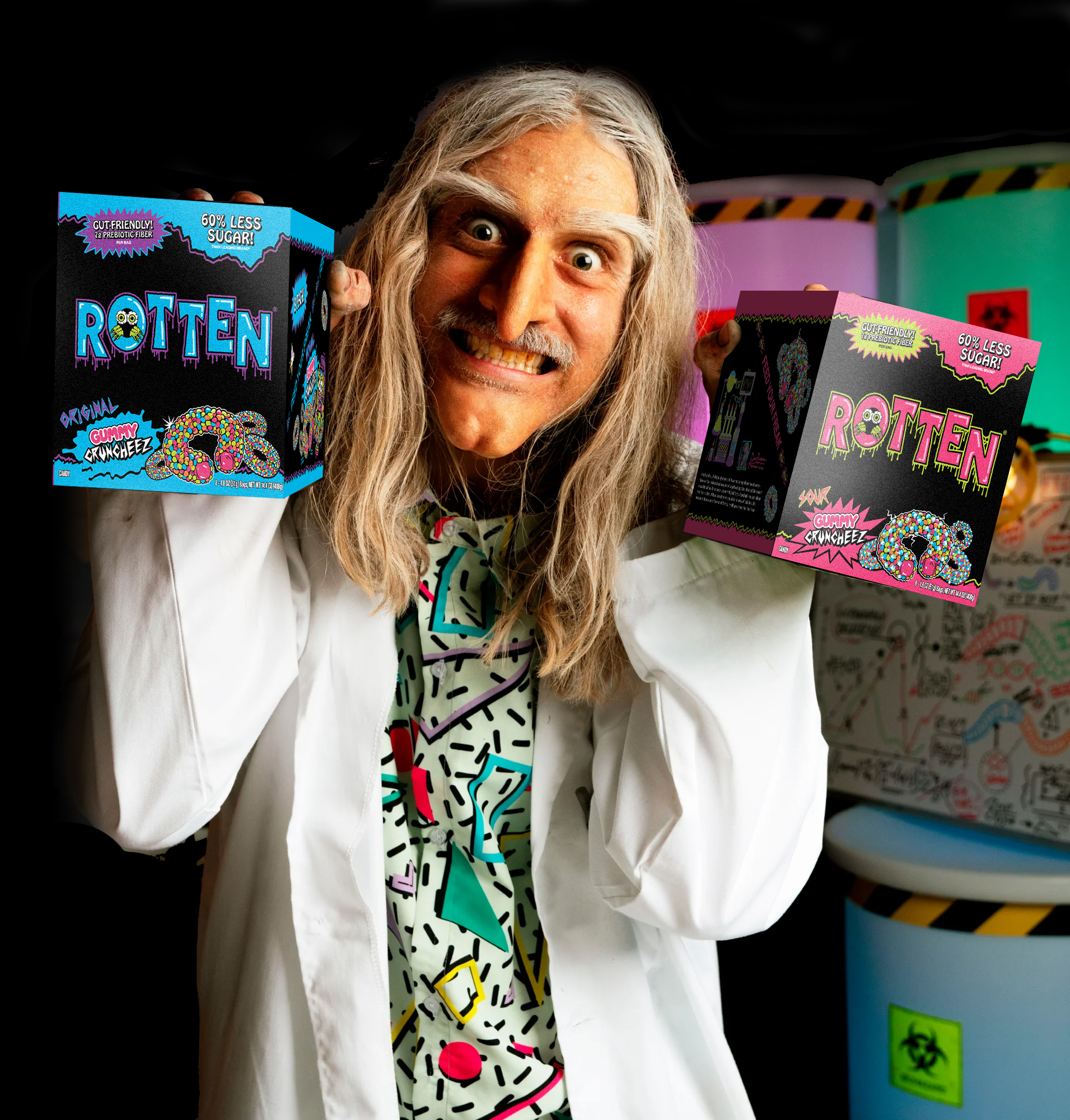
Many challenger brands start DTC with highly creative packaging, then shift to retail and have to become more descriptive. It feels like Rotten hasn’t had to do that. Was that intentional? Was there any advice that you can give other founders who might be reading this to always think about retail from day one, or was it just sort of like a happy accident?
We did think about retail early, but our packaging has evolved a lot. We haven’t rebranded entirely, just refreshed, but most changes came because our packaging was failing in retail.
For example, friends once texted me photos of the wrong flavour. That was a big problem. It made us realise we needed to be clearer and simpler, with stronger visual cues, bigger illustrations and clearer colour differentiation.
One key decision was keeping our black packaging, which differentiates us in the candy aisle. Instead of adding lots of colour blocks, we simplified our logo. It used to be highly illustrated, but that got lost on shelves. Now it’s clearer and supports flavour differentiation.
It’s so impressive that your core design world has survived all stages of growth. Is there a piece of advice that you can give to a founder who's thinking about building a brand right now?
One important thing was building a brand world separate from packaging early on. I hated the idea that branding was just a logo, colour palette, and fonts. That felt shallow. Obviously you can't communicate everything on packaging, but I do think customers can tell when there might be more to something or a world behind something.
So we built a deeper world with stories and characters, like a mini movie or TV show. Customers don’t need to know it, but they can feel it. That’s why, even as packaging evolves, everything still feels consistent.
That's really interesting. Building something bigger that becomes a well that you can draw from that still feels cohesive and allows you to flex. That leads me onto something we call House Media – media channels that you own as a company. Do you have any “House Media”, channels you own where you express the brand in a Rotten way?
One thing that worked well was collaborating with artists. There are so many talented creatives who do not typically work in CPG. We found an illustrator on Instagram and worked with him on packaging, then expanded into trade show assets. That helped us stand out.
We lean into that approach with everything we do is, we try to find artists making cool things and work with those people. It’s more work, there can be technical challenges, but it’s incredibly valuable for creating something unique.
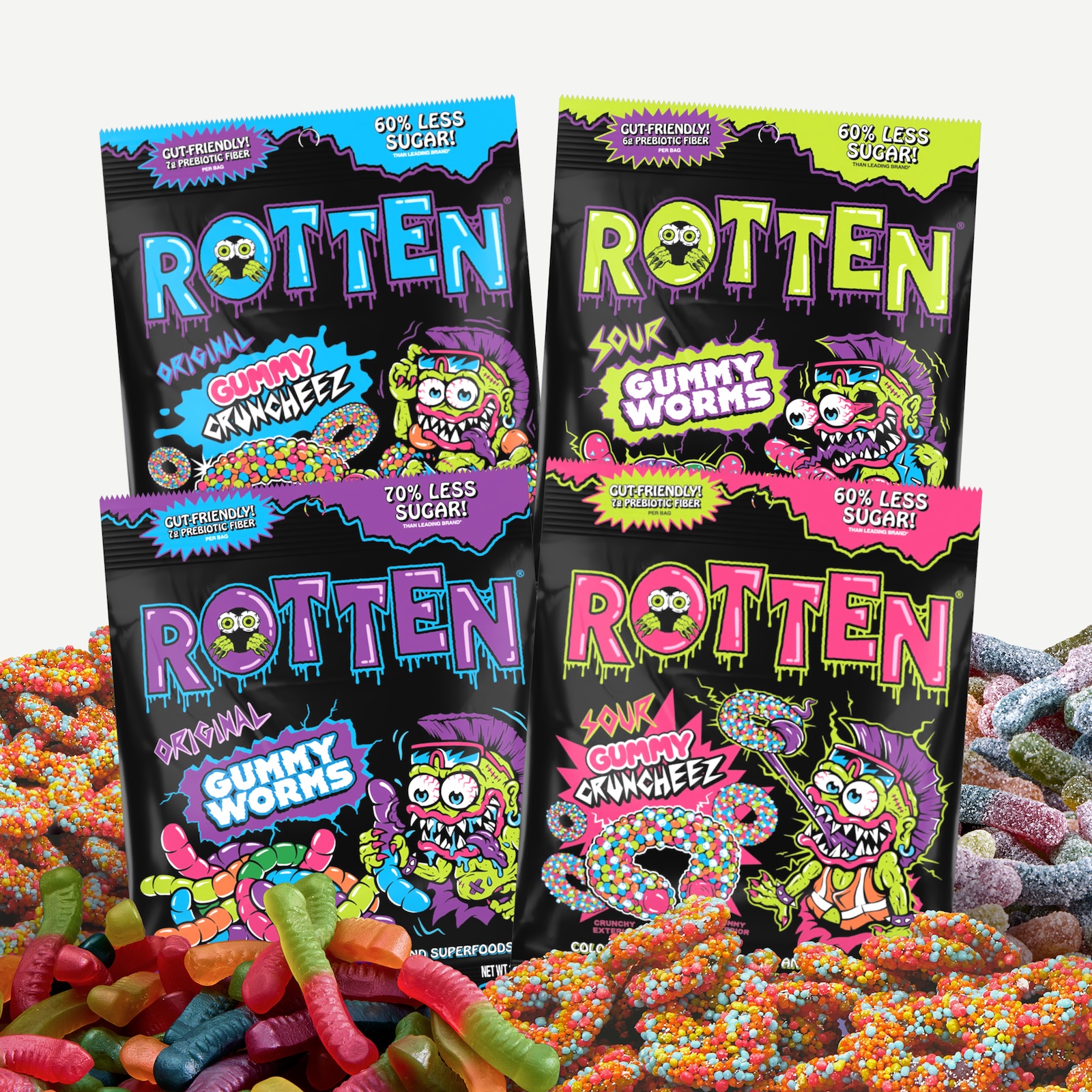
We've talked about a lot about design, but I noticed that for now, Rotten is sold in bags that a lot of the category also uses. Do you think about custom packaging formats as a future differentiator? For example, pill bottles from Dr Rotten. Are there any things that you would love to do that would make your brand even purer?
Yes, I do. But early on, we actually launched with compostable film and had lots of issues. That taught us that protecting product quality is the priority. That was a lesson early on.
Going back to the new versus familiar. Doing new things can be the more challenging things so sometimes you have to pick your battles. We're already formulating a ‘better for you’ product, we’re already investing heavily in a unique differentiated brand. Do we also want to innovate on packaging material? Where's our zone of genius? At least for now it won’t be packaging.
You’re a busy founder. You've got to choose what to focus on. And yet, you show up at Dick’s Sporting Goods, you show up at unusual places. I imagine you're really busy. I imagine that doing those deals leads to lower volume than grocery stores, but it's really interesting. I think I may have read you say something about how there's a higher perceived scale. For example, if we show up in Dick’s Sporting Goods, people think if they're here, they must be everywhere. Why does that strategy work?
That strategy has been amazing for us. Early on one of our first retail partners was Zumiez, I think there's a few benefits to it. One, we're in spaces where the category sets are much smaller, so we're in Zumiez competing with three other candy brands at checkout, versus a grocery store where there's dozens. Often in those spaces, we are also the only ‘better for you’ brand and so it is a less competitive space.
I think the second piece is that it is for a super targeted customer, more so than a grocery store or a mass store. Whoever is going into Dick’s Sporting Goods, whoever is going into Zumiez they are a certain type of person versus the wide array of people going into a grocery store. You can target a specific customer.
The third piece is airport retail which has been huge for us, because of the surprise and delight factor, it feels unexpected. It also lends itself to helping us appear bigger than we are.
Really interesting. I won't bore you with it, but my backstory, is that I started a canned water brand in California at the same time as Liquid Death. When we were starting up, we were just doing DTC, and if we're going to do retail, we wanted it to be big grocery. That was a completely wrong calculation, because at that time, Liquid Death was going into skate shops and tattoo parlours. I remember seeing them being like “that takes so much time, there's so much paperwork, there's so much onboarding, there's so much compliance and insurance to sell a dozen cases”, why? And clearly, I'm not worth $1.6 billion now, so I think they were right about something.
You're not wrong. I saw Liquid Death early on and thought it was super interesting, and in a lot of ways, I think early on, tried to emulate it, but I wouldn't say that strategy worked for us at the beginning. Zumiez is very different than going after independent skate shops, that is really hard to do as a growth strategy early on but going for the slightly larger chains worked better for us.
I think the other the funny piece too, is our brand has just grown naturally, and now we are in mass conventional retailers. We're on platforms like Faire and other places where small independent stores can still order us. It's as we've grown the rest of our business; those businesses have just found us and that's worked better for us.

Functional ingredients is a trendy word. Would you use that word to describe yourselves? All the allulose and monk fruit, these things all sound quite functional, but I've never heard you talk about it.
All of our products have prebiotic fibre, which is our main functional benefit.
But we want to be seen as a candy brand first, not a functional food. When you think of delicious candy we want you to think about Rotten which means not talking about things like our functional ingredients. That means not leading with those claims.
At the same time, we need to justify our premium price, so we do communicate those benefits. It’s a balance. Everything we do is ensure people understand the value of our product, but at the same time we make sure Rotten is a candy brand first.
Is it better to lead with brand and taste rather than function? Do you think that means that you can access a bigger market than the natural and organic candy customer base?
"Better for you’ is our biggest thesis behind brand and company. The low/zero sugar category is growing very quickly. But if you position yourself as “healthy candy,” your market is smaller. But if you position as a candy brand, you can access the entire category.
Private label seems to be the biggest scary threat for most big and established brands. I get a sense, though, that you're quite protected from it. Are you worried about it?
One interesting dynamic is the candy category under indexes for private label, at least in the US. Because compared to other food people associate a taste or texture, very specifically with a brand, and are highly nostalgic for that specific experience. Generally, most people are not like ‘I really want a sour gummy worm right now’. They want a specific brand of sour gummy worm.
Also, there's a perception of private label candy as just being the cheap, crappy stuff. So I think we feel protected as a category, and how consumers buy the category.
But then I think more broadly that’s why investing in brand has never been so important. Our brand is so distinctive that copying it would look like a cheap knockoff. That’s why we cannot rely on product alone. We need to build a brand that people give a shit about.
I'd love to ask one final thing. What are your plans five years from now, where are you going to be?
I'm just super excited about getting our products more widely available for people to shop. Candy is such an impulsive category that if you're not where someone is when the craving hits, then you're not the product they're going to buy. So that's super exciting to me.
We've got a tonne of new product development. We have a couple new products coming out this summer that are very innovative and are the culmination of the hardest R&D we've ever done. I get really excited about hard R&D and pushing the category forward.
Ultimately, I want to build a legacy candy brand, something people grow up with. In five years, I hope we are starting to see that become a reality.
What category behaviour is Rotten challenging? Are there any mindset assumptions, or category assumptions that you're fighting against?
I think there are two main assumptions that we're fighting; one of them is around product, and the other is around brand.
On the product side, we challenge the notion that you need a bunch of terrible ingredients to make a really good tasting candy or product.
On the brand side, what we're really challenging is the idea that if you are making a “better for you” product with healthier ingredients, your brand needs to look healthy. We very intentionally designed a brand to look the exact opposite of what someone's expectations might be based on the product.
We've heard it said by people who study innovation that if your innovation is completely unexpected, the market won't know what to do with it. A common rule is 80% familiar and 20% fresh. I don’t want to assume, but it feels like you break that rule a bit. First, do you agree with that assessment? And second, what challenges do you face by being so different?
It’s a great point, and something I think about a lot when we’re designing anything, whether it’s the product or the packaging. I don’t know if I have a firm rule in my head like 80-20, but it’s about how we can feel familiar to people.
Because our brand is new to them, we also need to ensure that the product we’re making is different from what’s already out there, so that part will naturally feel new.
So what are the ways we can still make it feel familiar? Some examples: the flavours in our candy are classic candy flavours for the gummy kid category. We are not introducing novel, foodie type flavours. Ours are blueberry, raspberry, cherry, strawberry, orange, lime, your classics.
We’ve also focused on product formats people are familiar with. Everyone knows what a gummy worm is, and our gummy crunchies are based on a familiar format, a crunchy outside with a gummy inside.
And then our brand is obviously new, but it’s built off many different references from the same kind of funny world. Every person I talk to says, “your brand reminds me exactly of X,” and while the references differ, they’re all similar and they’re all right. The brand was built off a host of cool historical references that we intentionally used to create a sense of nostalgia.
So just to clarify, you’re saying that while it might feel fresh and unexpected for the candy category in 2026, there’s actually a lot of familiarity buried underneath? Like a childhood memory of how candy is supposed to taste or how fun things are supposed to look?
Yeah, exactly. There are so many ways to find that balance between novel and familiar. You can also play with the idea that something is broadly familiar but feels novel within the candy category. That’s an interesting space to explore too.
We often say a brand for everyone is a brand for no one. Good challengers divide the world. Rotten definitely divides the world. You call out negative reviews and even call people “wimps,” which is hilarious. But I imagine you also divide buyers, people who don’t know where to place you in store. Can you talk about that?
I remember early on, there was a broker that an advisor connected us with. I was super excited about working with them. Then I sent them the product, they showed it to their team, and ultimately they passed.
They said that because we are a 'better for you' product, like others in the premium low-sugar space, we have that kind of price point, but our packaging looks like conventional candy. They said they would never work with us.
It was funny to me, because that’s the whole point. They had identified our reason to exist. Still, it sucks getting feedback like that.
I concluded that if we’re not getting responses like that, then what we’re doing probably isn’t very new or interesting. If everyone gets it and agrees immediately, it’s probably already been done.
We’ve also had retailers who still won’t stock us. One conservative retailer loved the product but said they couldn’t put a brand called “Rotten” on their shelves.
Have you noticed the opposite, that for every rejection, there’s deeper love from the people who do choose you? Is there higher velocity? What have you noticed from those people that do get it and do pick you up?
Yes, there is huge love for our brand, even before people try the product. Our brand is art and creativity forward, and we resonate deeply with that audience.
But the biggest thing is how memorable we are. We get so many reactions from people who have only seen us once, like someone spotting us in Denver Airport, and they remember us. How often do you see a brand like ours? It’s eye catching and memorable.
As an emerging challenger brand, we don’t have the budget to be everywhere constantly. So our packaging has to do a lot of the work. Whether people love us or hate us, at least they remember us.
We even quantified this. We ran a study on brand memorability and found that our brand is six times more memorable than the average brand in the US, according to Meta.
Many challenger brands start DTC with highly creative packaging, then shift to retail and have to become more descriptive. It feels like Rotten hasn’t had to do that. Was that intentional? Was there any advice that you can give other founders who might be reading this to always think about retail from day one, or was it just sort of like a happy accident?
We did think about retail early, but our packaging has evolved a lot. We haven’t rebranded entirely, just refreshed, but most changes came because our packaging was failing in retail.
For example, friends once texted me photos of the wrong flavour. That was a big problem. It made us realise we needed to be clearer and simpler, with stronger visual cues, bigger illustrations and clearer colour differentiation.
One key decision was keeping our black packaging, which differentiates us in the candy aisle. Instead of adding lots of colour blocks, we simplified our logo. It used to be highly illustrated, but that got lost on shelves. Now it’s clearer and supports flavour differentiation.
It’s so impressive that your core design world has survived all stages of growth. Is there a piece of advice that you can give to a founder who's thinking about building a brand right now?
One important thing was building a brand world separate from packaging early on. I hated the idea that branding was just a logo, colour palette, and fonts. That felt shallow. Obviously you can't communicate everything on packaging, but I do think customers can tell when there might be more to something or a world behind something.
So we built a deeper world with stories and characters, like a mini movie or TV show. Customers don’t need to know it, but they can feel it. That’s why, even as packaging evolves, everything still feels consistent.
That's really interesting. Building something bigger that becomes a well that you can draw from that still feels cohesive and allows you to flex. That leads me onto something we call House Media – media channels that you own as a company. Do you have any “House Media”, channels you own where you express the brand in a Rotten way?
One thing that worked well was collaborating with artists. There are so many talented creatives who do not typically work in CPG. We found an illustrator on Instagram and worked with him on packaging, then expanded into trade show assets. That helped us stand out.
We lean into that approach with everything we do is, we try to find artists making cool things and work with those people. It’s more work, there can be technical challenges, but it’s incredibly valuable for creating something unique.
We've talked about a lot about design, but I noticed that for now, Rotten is sold in bags that a lot of the category also uses. Do you think about custom packaging formats as a future differentiator? For example, pill bottles from Dr Rotten. Are there any things that you would love to do that would make your brand even purer?
Yes, I do. But early on, we actually launched with compostable film and had lots of issues. That taught us that protecting product quality is the priority. That was a lesson early on.
Going back to the new versus familiar. Doing new things can be the more challenging things so sometimes you have to pick your battles. We're already formulating a ‘better for you’ product, we’re already investing heavily in a unique differentiated brand. Do we also want to innovate on packaging material? Where's our zone of genius? At least for now it won’t be packaging.
You’re a busy founder. You've got to choose what to focus on. And yet, you show up at Dick’s Sporting Goods, you show up at unusual places. I imagine you're really busy. I imagine that doing those deals leads to lower volume than grocery stores, but it's really interesting. I think I may have read you say something about how there's a higher perceived scale. For example, if we show up in Dick’s Sporting Goods, people think if they're here, they must be everywhere. Why does that strategy work?
That strategy has been amazing for us. Early on one of our first retail partners was Zumiez, I think there's a few benefits to it. One, we're in spaces where the category sets are much smaller, so we're in Zumiez competing with three other candy brands at checkout, versus a grocery store where there's dozens. Often in those spaces, we are also the only ‘better for you’ brand and so it is a less competitive space.
I think the second piece is that it is for a super targeted customer, more so than a grocery store or a mass store. Whoever is going into Dick’s Sporting Goods, whoever is going into Zumiez they are a certain type of person versus the wide array of people going into a grocery store. You can target a specific customer.
The third piece is airport retail which has been huge for us, because of the surprise and delight factor, it feels unexpected. It also lends itself to helping us appear bigger than we are.
Really interesting. I won't bore you with it, but my backstory, is that I started a canned water brand in California at the same time as Liquid Death. When we were starting up, we were just doing DTC, and if we're going to do retail, we wanted it to be big grocery. That was a completely wrong calculation, because at that time, Liquid Death was going into skate shops and tattoo parlours. I remember seeing them being like “that takes so much time, there's so much paperwork, there's so much onboarding, there's so much compliance and insurance to sell a dozen cases”, why? And clearly, I'm not worth $1.6 billion now, so I think they were right about something.
You're not wrong. I saw Liquid Death early on and thought it was super interesting, and in a lot of ways, I think early on, tried to emulate it, but I wouldn't say that strategy worked for us at the beginning. Zumiez is very different than going after independent skate shops, that is really hard to do as a growth strategy early on but going for the slightly larger chains worked better for us.
I think the other the funny piece too, is our brand has just grown naturally, and now we are in mass conventional retailers. We're on platforms like Faire and other places where small independent stores can still order us. It's as we've grown the rest of our business; those businesses have just found us and that's worked better for us.
Functional ingredients is a trendy word. Would you use that word to describe yourselves? All the allulose and monk fruit, these things all sound quite functional, but I've never heard you talk about it.
All of our products have prebiotic fibre, which is our main functional benefit.
But we want to be seen as a candy brand first, not a functional food. When you think of delicious candy we want you to think about Rotten which means not talking about things like our functional ingredients. That means not leading with those claims.
At the same time, we need to justify our premium price, so we do communicate those benefits. It’s a balance. Everything we do is ensure people understand the value of our product, but at the same time we make sure Rotten is a candy brand first.
Is it better to lead with brand and taste rather than function? Do you think that means that you can access a bigger market than the natural and organic candy customer base?
"Better for you’ is our biggest thesis behind brand and company. The low/zero sugar category is growing very quickly. But if you position yourself as “healthy candy,” your market is smaller. But if you position as a candy brand, you can access the entire category.
Private label seems to be the biggest scary threat for most big and established brands. I get a sense, though, that you're quite protected from it. Are you worried about it?
One interesting dynamic is the candy category under indexes for private label, at least in the US. Because compared to other food people associate a taste or texture, very specifically with a brand, and are highly nostalgic for that specific experience. Generally, most people are not like ‘I really want a sour gummy worm right now’. They want a specific brand of sour gummy worm.
Also, there's a perception of private label candy as just being the cheap, crappy stuff. So I think we feel protected as a category, and how consumers buy the category.
But then I think more broadly that’s why investing in brand has never been so important. Our brand is so distinctive that copying it would look like a cheap knockoff. That’s why we cannot rely on product alone. We need to build a brand that people give a shit about.
I'd love to ask one final thing. What are your plans five years from now, where are you going to be?
I'm just super excited about getting our products more widely available for people to shop. Candy is such an impulsive category that if you're not where someone is when the craving hits, then you're not the product they're going to buy. So that's super exciting to me.
We've got a tonne of new product development. We have a couple new products coming out this summer that are very innovative and are the culmination of the hardest R&D we've ever done. I get really excited about hard R&D and pushing the category forward.
Ultimately, I want to build a legacy candy brand, something people grow up with. In five years, I hope we are starting to see that become a reality.

Putting the joy back into work (with Bruce Daisley)
If work takes up so much of our lives, and so much of work’s output is down to discretionary effort, how do we make work more engaging - as leaders of teams, and as workers ourselves?
Bruce Daisley has become a world expert on it. Previously the MD of YouTube in the UK, Bruce was the European Head of Twitter when he started exploring the meaning and future of work in a podcast, Eat Sleep Work Repeat. His first book, The Joy of Work, was a Sunday Times number one business bestseller and an FT Book of the Month. He is also the host of the hugely successful podcast ‘Eat Sleep Work Repeat’.
In this episode Adam and Bruce first discuss how to get rid of the things that suck the joy out of work, and then how to create a positive buzz in our engagement, as an individual and as a team.
They talk about:
- What the really big disruption in work has been (and it’s not wfh)
- The essential foundations for making any impact whatsoever on engagement in a culture
- The two key indicators of real engagement at work
- Why idle time is so important
- The real enemy of productivity in an organisation
- The power of Positive Affect
- The surprising importance of laughter
And why, when so much is known about how to drive up engagement at work, so little of that knowledge makes it into the leadership meetings of big organisations.
Listen to Eat Sleep Work Repeat:
Apple: https://podcasts.apple.com/gb/podcast/eat-sleep-work-repeat/id1190000968
Spotify: https://open.spotify.com/show/5KUW5Lu36O4nnfIFqIIUh4
Bruce's books:
The Joy of Work: 30 Ways to Fix Your Work Culture and Fall in Love with Your Job
Fortitude: The Myth of Resilience, and the Secrets of Inner Strength
__
Follow Adam on Linkedin: https://www.linkedin.com/in/adam-morgan-3a473a/
Let's Make This More Interesting is a podcast from eatbigfish. Thanks to our editor Ruth, our producer Travis, and to Tiny Podcasts.
Lessons, Frameworks, Power and Sex (a look back at Season 1)
In this bonus episode Adam summarises the key themes and learnings across all the guests from the first season, to make it useful and usable for you.
He breaks his conclusions into five sections:
1. The Cost of Dull and the Value of Interesting
2. The Four Kinds of Dull
3. Finding the right way to be interesting for you
4. Common themes and key ideas across all the guests
5. How to use it
Read the full transcript of the episode at The Challenger Project.
---------
Connect with Adam on LinkedIn: https://www.linkedin.com/in/adam-morgan-3a473a/
Follow eatbigfish on Linkedin and Instagram
With thanks to our editor Ruth and producer Ross.
Leading the world towards hope (with Gail Gallie)
We’re at an inflection point in how we engage people about the UN’s Sustainable Development Goals, Gail Gallie believes: we now need a completely new model – ‘The gloves are off’. Gail left a successful career in advertising and at the BBC to help set up Project Everyone with campaigner and film director Richard Curtis – their aim: to communicate the UN’s Sustainable Development Goals to everyone in the world in one week. 10 years later, she remains a relentless campaigner and innovator around communicating the SDGs, including the podcast she hosts with Loyiso Madinga, ‘An Idiot’s Guide to Saving The World’.
In this week's episode, Gail and Adam discuss:
- How the combination of a big ambition and a fierce time constraint drove breakthrough solutions for Project Everyone
- The new context: how the whole world has changed, and we need to move on from the old model now
- What this new model of impact campaigning should look like
- The role of surprise here, and how to get the most value from it
- Why the creative campaigning community now has to go for broke
- What it means to engage people in the conversation where they care when it comes to the SDGs, and in language they can relate to
And, in Richard Curtis’ words ‘What is the sound of hope we can make against the noise of despair?’
__
Follow Adam on Linkedin: https://www.linkedin.com/in/adam-morgan-3a473a/
Let's Make This More Interesting is a podcast from eatbigfish. Thanks to our editor Ruth, our producer Travis, and to Tiny Podcasts.
Giving up the gold (with Nick Reed)
Named ‘one of the most 10 influential Brits in Hollywood’ by The Sunday Times, Nick Reed has been a successful Hollywood agent, won an Oscar for a documentary called ‘The Lady in Number 6’, and co-founded the most successful viral content company in the US.
In this episode, Nick discusses with Adam what makes something not just more interesting, but interesting enough to share – along with what it’s like to celebrate winning an Oscar with Bill Murray, how to get cast in a Steven Spielberg film, and how to get a Hollywood studio to buy a writer that nobody wants to buy. And at the heart of Nick’s philosophy is what he calls ‘giving up the gold’: giving value to the other person early, without expecting anything in return. A longer episode that ends this first season, we hope you enjoy it.
Nick's company - Shareability: https://www.shareability.com/
Follow Nick on Linkedin: https://www.linkedin.com/in/nick-reed-79269731/
Watch Nick's Oscar winning film, The Lady in No. 6, here: http://nickreedent.com/
---------
Connect with Adam on LinkedIn: https://www.linkedin.com/in/adam-morgan-3a473a/
Follow eatbigfish on Linkedin and Instagram
With thanks to our editor Ruth and producer Ross.
Interesting at the speed of culture (with Nick Tran)
Is TikTok the most interesting platform in the world? What’s at the heart of its success – and what does it mean to be more interesting in a post TikTok world, when the audience on TikTok is “10x bigger every day than the Super Bowl”?
In this week’s episode, Adam meets Nick Tran, former Global Head of Marketing at TikTok and advisor to a new generation of Challengers, including tech company Nothing. Nick brings his experience as a marketer, advisor and investor to discuss:
- How TikTok has changed the playing field for a new generation of brands
- How he led ‘Project Cheetah’ to reduce TikTok’s campaign development cycle from 10 weeks to a few days.
- The creativity that financial and time constraints force you to develop
- Why he always looks for win-win-win partnerships
- Learning how to create a ’must-see’ piece of creative work
- Why he believes in moving creative in-house to speed up social
- The need for a balanced diet of marketing measurement beyond KPIs and ROI
__
Connect with Nick on Linkedin: https://www.linkedin.com/in/nicholastran/
Follow Adam on Linkedin: https://www.linkedin.com/in/adam-morgan-3a473a/
Let's Make This More Interesting is a podcast from eatbigfish. Thanks to our editor Ruth, our producer Travis, and to Tiny Podcasts.
The third American art form (with Russell Davies)
Powerpoint has become the poster child of Dull – can even this most maligned of mediums really be a tool to be more interesting? Russell Davies not only believes it can, but that it’s the third American art form, along with jazz and hip hop – but only if we think of it and use it in a very different way. It seems such a symbolic flip for the cliché of ‘Death by Powerpoint’, that we’ve given it its own short episode. Here Russell shares his very simple rules for really engaging an audience through Powerpoint.
Russell's book: Do Interesting. Notice. Collect. Share.
https://thedobook.co/products/do-interesting-notice-collect-share
_______
Connect with Adam on LinkedIn: https://www.linkedin.com/in/adam-morgan-3a473a/
Follow eatbigfish on Linkedin and Instagram
With thanks to our editor Ruth and producer Ross.
Creating character at Dishoom (with Sara Stark)
For 10 years Sara Stark was part of the team helping the founders of Dishoom build their restaurant brand and business – a brand that is as rich, engaging and layered as so many other restaurants are superficial and glib.
It’s a conversation about stories, and curiosity, and inventiveness, and layering, and pushing the idea. About a continual commitment to exploring and digging and experimenting and keeping things fresh. About thinking about what it means to be different, genuinely different and engaging, in a way that seems entirely unlike the rest of the business.
If you are remotely interested in brand building, experience or culture the Dishoom story is an inspiration.
Connect with Sara on Linkedin https://www.linkedin.com/in/sara-stark-creative-marketing/
Explore the layers of the Dishoom story at https://www.dishoom.com/
__
Follow Adam on Linkedin: https://www.linkedin.com/in/adam-morgan-3a473a/
Let's Make This More Interesting is a podcast from eatbigfish. Thanks to our editor Ruth, our producer Travis, and to Tiny Podcasts.
Making the magic more probable (with Russell Davies)
One of the most stimulating speakers in brands and communications, Russell has been thinking about what it means to be interesting for over 20 years. In his new book Do Interesting – Notice. Collect. Share. Russell has codified the practice he’s used to make the world more interesting to him, and to make himself better positioned to bring interest to whatever topic he finds himself working on, inside and outside the world of brands. In this episode he shares how we can do it easily, too.
https://thedobook.co/products/do-interesting-notice-collect-share
_______
Connect with Adam on LinkedIn: https://www.linkedin.com/in/adam-morgan-3a473a/
Follow eatbigfish on Linkedin and Instagram
With thanks to our editor Ruth and producer Ross.
The question is more important than the answer (with Warren Berger)
Warren Berger began exploring how to ask better questions through a journalistic interest in innovation. He’s come to believe the importance of questions is much broader than that, and has come on to champion the development of better questioning skills in everything from education to our personal relationships.
He has written widely on the topic, including ‘A More Beautiful Question: The power of inquiry to spark breakthrough ideas’.
In a discussion of some of his central findings and ideas we talk about:
- Why the question can be more important than the answer
- What makes a question dull or interesting
- How a good question shifts things
- The power of ‘Questionstorming’
- How a good question ‘attracts’ answers
- His three part model to asking better questions
- Why businesses should think about having Mission Questions, rather than Mission Statements
And the power for all of us in having three big questions that guide our lives.
Find out about Warren's books on his website: https://warrenberger.com/warren-bergers-books/
__
Connect with Adam on Linkedin: https://www.linkedin.com/in/adam-morgan-3a473a/
Let's Make This More Interesting is a podcast from eatbigfish. Thanks to our editor Ruth, our producer Travis, and to Tiny Podcasts.
Lashing the world with story (with John Yorke)
While storytelling isn’t the automatic answer to every kind of ‘dull’, if we’re going to learn how to tell more interesting stories we should learn from the best. John Yorke founded the BBC Studio Writer’s Academy after a career that included being Head of Channel4 Drama and Controller of BBC Drama Production, working on and producing some of the world’s most widely viewed and critically acclaimed TV drama, from EastEnders to Shameless, Life on Mars and Wolf Hall. In this episode, he shares with Adam his learnings about how we can all tell a story that will really engage our audience.
Read John’s book: Into The Woods: How stories work and why we tell them
John’s company and training services: https://www.johnyorkestory.com/
_______
Connect with Adam on LinkedIn: https://www.linkedin.com/in/adam-morgan-3a473a/
Follow eatbigfish on Linkedin and Instagram
With thanks to our editor Ruth and producer Ross.
How to tell a big story in just 90 seconds (with Louisa Preston and Luisa Baldini)
How do you engage an audience in something that really matters in just 90 seconds? Where do you start? How do you overcome the ‘curse’ of everything you know?
In this episode Adam talks with two former BBC reporters, Louisa Preston and Luisa Baldini, about how they become experts in being compelling in 90 seconds, in careers where they covered everything from the 7/7 bombings and the Amanda Knox trials to interviewing Richard Gere on the red carpet. They now have their own business, Composure Media, that helps executives become brilliantly succinct themselves.
They discuss:
- Their model for engaging in 90 seconds: ‘Hook, Line, and Sinker’
- Why you should always start with your strongest ‘picture’
- Overcoming the curse of expertise
- The importance of the story that only you know
- How to manage a confidence crisis
- What to do when your Hollywood star goes rogue on live TV
And we close by discussing a big part of their work today: helping female executives develop a more confident elevator pitch and presence.
Find out about Louisa and Luisa's work here: https://www.composure.media/
___________
Connect with Adam on Linkedin: https://www.linkedin.com/in/adam-morgan-3a473a/
Let's Make This More Interesting is a podcast from eatbigfish. Thanks to our editor Ruth, our producer Travis, and to Tiny Podcasts.
The interesting Squiggle and the long ‘Aha’ (with Helen Tupper and Sarah Ellis)
The Squiggly Careers podcast has been hugely influential and useful for anyone interested in Career Development community. In this episode I talk to Sarah Ellis and Helen Tupper, the brilliant pair behind the podcast, the two bestselling books that have come out of it – Squiggly Careers and You Coach You – and the company they have founded, Amazing if.
We discuss:
- How, in looking to throw out the old model of the ‘career ladder’, they arrived at that fascinating idea and language of the ‘squiggle’
- How they’ve found a much more engaging way to talk to people about confidence issues, and why it works
- Why dullness in large organisations is often a kind of conformity
- How to be a ‘helpful rebel’ in big companies if you want to help shake up dull practices
Along the way, they talk about a fascinating idea: ‘the long aha’ – that realisation that comes to you sometime after an engaging moment in a meeting, prompting you to question something you are doing, when you realise how pervasive that practice and issue has been in your life. As fascinating and useful as you would expect from the inimitable Sarah and Helen.
Listen to the Squiggly Careers podcast
Find out more about Amazing If's work
Helen and Sarah's books:
________
Connect with Adam on LinkedIn: https://www.linkedin.com/in/adam-morgan-3a473a/
Follow eatbigfish on Linkedin and Instagram
With thanks to our editor Ruth and producer Ross.
The five components of interesting (with Jeffre Jackson and Dave Nottoli)
This week Adam talks to renowned planners David Nottoli and Jeffre Jackson about their research into ‘interestingness’ in advertising.
Drawing from their experience David and Jeffre share their definition of the five key components of interesting:
- How incongruity reinforces memory
- Why Don Draper might be wrong about emotions
- The significance of fish sticks
- Why authenticity isn’t just a buzzword
- Why the details really matter, even if 99% of people don’t notice them
We also learn why we should avoid chasing empty spectacle in the battle for attention, why Nike’s legendary work with athletes can’t be replicated by just any sports brand, what the classic Cadbury’s Gorilla ad teaches us about mystery, and the risk of being sucked into the ‘boreplex’.
Watch Jeffre’s 2006 video on Interestingness: how interesting ads work differently, and what value Interestingness delivers for marketers.
Nike x Charles Barkley “I am not a role model”
Nike x Tiger Woods "I Am Tiger Woods"
___________
Connect with Adam on Linkedin: https://www.linkedin.com/in/adam-morgan-3a473a/
Let's Make This More Interesting is a podcast from eatbigfish. Thanks to our editor Ruth, our producer Travis, and to Tiny Podcasts.
Using surprise to grow (with Kyrsten Halley)
In this episode Adam Morgan explores what it takes to use surprise effectively as an integral part of a challenger’s strategy. His guest is Kyrsten Halley, the former Marketing Director of Aldi UK, part of a team that for years has been putting the purposefully unexpected into the drudgery of the weekly grocery shop. One of the key ways Aldi has grown to become one of the Big Four in the UK.
Adam and Kyrsten unpack how and why a discount supermarket came to offer the world's best champagne for £14.99, restaurant-quality lobster tails at Christmas, and a kayak in the middle aisle: where the real value lies for them in being consistently surprising, and the ‘share of heart’ they look to build through it. And why none of that worked without a real rigour and discipline across the business underpinning it.
The conversation explores:
- How ‘delighting the customer with surprise’ can create that ‘chink of open-mindedness’ Aldi needs to grow
- How the origin of so much of what Aldi does lies in its challenger roots as a Democratiser – making goods available that many UK shoppers would have historically felt they couldn’t afford
- How the constraints of Aldi’s discount format stimulated the thinking around their famous ‘Special Buys’
- The strong relationships between the different areas of the business, and why they are so important.
- The codes of premium private label they felt they could and couldn’t break
- Why being consistently surprising, week in week out, really helps find the right boundaries with your audience
- Why Aldi maintains a challenger mindset even though they are now the fourth biggest UK supermarket
- What it really means to make a brave idea feel obvious to the rest of the business.
This conversation also formed part of the research for eatbigfish's Cannes Lions 2026 session, "The Startling Power of Surprise" with The Uncensored CMO Jon Evans— the latest chapter in the multi-year Cost of Dull project. For more on the Cost of Dull and the effective strategic use of Surprise, visit eatbigfish.com.
___
Let's Make This More Interesting is a podcast from eatbigfish: the strategic consultancy that helps ambitious Challengers to grow.
Thanks to our editor Ruth and our producer Rachael.
Two thousand years more interesting (with Professor Arlene Holmes-Henderson)
In this episode we talk to Professor Arlene Holmes-Henderson, Professor of Classics Education and Public Policy at Durham University, about her fierce belief in the enduring relevance of classical rhetoric to today’s world, and why its value in helping disadvantaged children find their voice in a more engaging way is fundamental to how schools need to develop oracy, alongside literacy and numeracy. And at the end, she gives a 10-minute masterclass in classical rhetoric that we can all use to make a speech more interesting.
_____________
Arlene's books Forward with Classics and Expanding Classics
The ‘Shy bairns get nowt’ project https://www.durham.ac.uk/news-events/latest-news/2023/05/shy-bairns-get-nowt/
Arlene's work in The Guardian https://www.theguardian.com/education/2023/jun/04/brucey-and-caesar-can-help-children-improve-oracy-says-classic-professor
Connect with Adam on LinkedIn: https://www.linkedin.com/in/adam-morgan-3a473a/
Follow eatbigfish on Linkedin and Instagram
With thanks to our editor Ruth and producer Ross.
Does our attention define us? (with Faris Yakob)
Faris Yakob believes that attention is not merely the first step to engagement with something, but a fundamental shaper of who we are: if ‘we are what we eat’, then what we pay attention to comes to define us.
The author of ‘Paid Attention’ and co-founder of Genius Steals, he and his wife Rosie have spent the last ten years as modern nomads, consulting, speaking and writing. In this episode Adam and Faris discuss:
- How Faris’ diverse career and nomadic life has been ‘a quest for interesting’
- Why attention is part of the substance of our existence
- Why it is impossible to buy attention today …
- …And yet everyone is still competing for our attention all the time
- Strategies for earning attention in a saturated media age
- Why the ‘most interestingness’ comes in the connection of domains that are not obviously connected
Follow Faris on Linkedin: https://www.linkedin.com/in/farisyakob/
Subscribe to Faris and Rosie's substack 'Strands of Genius': https://geniussteals.substack.com/
Connect with Adam on Linkedin: https://www.linkedin.com/in/adam-morgan-3a473a/
Let's Make This More Interesting is a podcast from eatbigfish. Thanks to our editor Ruth, our producer Travis, and to Tiny Podcasts.
The magic of Aardman (with Magda Osinska)
In this episode of Let’s Make This More Interesting from eatbigfish, Adam Morgan explores what it takes to be more interesting in a very different medium: stop frame animation. Madga Osinska, today’s guest, is a director of short films and commercials for the world-famous Aardman Animations, besides her own projects, and a winner of jury prizes throughout Europe for her work.
Adam and Magda unpack what it takes to really deliver Aardman’s four principles – comedy, story, character and craft – alongside the value of constraints in forcing you to find better ways to tell your story. And what it really means to explore the human condition in plasticine.
The conversation explores:
- The combination of heartwarming and heartbreaking in creating audience engagement
- How to give a character depth – and why flaws matter
- The real value of details and easter eggs
- Visual storytelling – using colour and shape to tell the story in parallel to the words
…And why you should be very, very careful never to win an Oscar
–
Let's Make This More Interesting is a podcast from eatbigfish: the strategic consultancy that helps ambitious Challengers to grow.
Thanks to our editor Ruth and our producer Rachael.
Hosted on Acast. See acast.com/privacy for more information.
How to win a peacock show (with Gemma Parkinson)
This is a podcast for people who can’t afford to bore their audience. And in this episode we talk to Gemma Parkinson, a Global Marketing and Business Director at Moet Hennessy, about how to elevate a presentation into an irresistible performance when you really need to carry an audience with you. A fresh, energetic and charismatic thinker, Gemma shares her advice about how to elevate the interest when it really matters.
____
Connect with Adam on LinkedIn: https://www.linkedin.com/in/adam-morgan-3a473a/
Follow eatbigfish on Linkedin and Instagram
With thanks to our editor Ruth and producer Ross.
A healthy dose of horror (with Mathias Clasen)
That’s enough about humour and the lighter side of interesting.
It’s time to step into the dark.
This week Adam meets researcher Mathias Clasen, co-founder of the ‘Recreational Fear Lab’ and author of Why Horror Seduces and A Very Nervous Person's Guide to Horror Movies, to talk about what he’s learned from haunted houses and horror movies, and how to find the ‘sweet spot’ of scary.
Adam and Mathias discuss:
- The definition of ‘recreational fear’, and why it’s not just for horror film fans
- The evidence that shows why fear is good for us. Why children need more ‘risky play’ for their development than we are giving them, and the surprising results of Mathias’ research into fear on our immune systems
- The physiological and cognitive relationship between fear and enjoyment
- Why we should all make friends with Mr Piggy
_
Read Mathias's books:
A Very Nervous Person's Guide to Horror Movies
Watch Mathias's TedX talk: Lessons from a terrified horror researcher
Connect with Adam on Linkedin: https://www.linkedin.com/in/adam-morgan-3a473a/
Let's Make This More Interesting is a podcast from eatbigfish. Thanks to our editor Ruth, our producer Travis, and to Tiny Podcasts.
Creating Epic Stories of High Fantasy (with Dungeon Master Jeffrey Robb)
What does it take to be interesting enough for people to brave the New York City subway to come and join you on a cold, wet, Tuesday night? Every Tuesday night? For two years?
In this episode, Adam Morgan is joined by Jeffrey Robb, professional Dungeon Master, actor, and educator, who runs paid games of Dungeons and Dragons up to eleven times a week across the five boroughs of New York. And what starts as a masterclass in epic, layered storytelling turns into something rather different. Because as Jeffrey explains, a great dungeon master isn't in fact there to tell an epic story; they're there to make it possible for a disparate group of people – with different motivations, different expectations, different levels of commitment – to create an epic story for themselves.
There's a lot here for anyone trying to hold a room. Jeffrey and Adam explore:
- The importance of choices in storytelling experiences: why giving people agency over the narrative creates ownership (- and why the best choices always leave room for a secret third option)
- Why it’s key to see the experience as ‘carefully managed chaos’: how the most inventive moments come from building a system flexible enough to be surprised by its own players
- Where you do and don’t want surprise , and why it has to work in two very different ways here
- The lessons Jeffrey learned from superhero comics and Shakespearean drama that he brings to the experiences he curates
- The primacy of trust, and what a "Session Zero" can teach anyone who needs to unlock a group's imagination fast
- What it means for good drama asks a question of its audience
Along the way, there's a squeaky goblin, why it’s unexpectedly dull to play a villain, and what increasing consumer expectations mean in D&D: why so many people now seem to want a burned village to avenge…
–
Let's Make This More Interesting is a podcast from eatbigfish: the strategic consultancy that helps ambitious Challengers to grow.
Thanks to our editor Ruth and our producer Rachael.
Hosted on Acast. See acast.com/privacy for more information.
On Saturn it’s raining diamonds (with Addison Brown)
How can we be interesting enough to stick in our audiences’ long-term memory? In this episode, Adam speaks to Addison Brown, the science teacher who was the star of a recent Department for Education recruitment film. They discuss the four key principles that underpin success in every lesson – from cognitive load to dual coding – and how shorter pupil attention spans and higher expectations have driven a ‘blossoming of imagination within teaching'.
'Every Lesson Shapes a Life': https://www.youtube.com/watch?v=aGd_Rrs-qNY
Brian Cox asks 'what more do you want?" https://www.youtube.com/watch?v=7uqa2TMzag4
_________
Connect with Adam on LinkedIn: https://www.linkedin.com/in/adam-morgan-3a473a/
Follow eatbigfish on Linkedin and Instagram
With thanks to our editor Ruth and producer Ross.
Stand up and make me laugh (with Chris Head)
Last week’s episode made the business case for humour - but how do we start to find our funny? This week Adam Morgan meets standup comedy writing and speaking coach Chris Head for a comedy masterclass.
Chris shares practical experience and techniques he uses when working with comedians, how he helped stand-up Stepfania Licari push her personal stories for the biggest payoff and coached Richard Lindesay to become a headliner (and TikTok star), all while punching up Adam’s jokes along the way,
They discuss:
- The power of comedy to help engage people with serious and challenging subjects
- Simple techniques to build humour and surprise into anything from a story to an internal announcement
- The importance of making an immediate connection with the audience to break the tension
- The craft involved to go from a joke-shaped thought into a bigger, funnier routine
- The power of misdirection (but not the magic kind)
_____
Contact Chris (or sign up to a course): https://www.chrishead.com/
Chris’s books:
Creating Comedy Narratives for Stage and Screen
A Director's Guide to the Art of Stand-up
The Complete Comedy Script Toolkit
_____
Connect with Adam on Linkedin: https://www.linkedin.com/in/adam-morgan-3a473a/
Let's Make This More Interesting is a podcast from eatbigfish. Thanks to our editor Ruth, our producer Travis, and to Tiny Podcasts.
Disrupting beliefs and breaking inertia (with Lucinda Barlow)
How engaging do you have to be, really, to break inertia? To disrupt beliefs? And what does that take in your communication and in your culture?
In this episode of Let’s Make This More Interesting, Adam Morgan is joined by Lucinda Barlow, who leads International Marketing at Uber across more than 60 countries. Drawing on a remarkable body of evidence spanning 19 communications campaigns around the world, Lucinda shares the two approaches that created real impact and drove growth, and the ones that didn’t.
They discuss the cultural forces driving dull work: mechanistic thinking, an obsession with productivity, the quiet presence of fear as the “8th passenger” in the room: how, together, they create a system that rewards mediocrity.
And Lucinda shares how and why she champions a challenger mindset in her team, even in a large company like Uber, and what it means for the way they both push for and protect more interesting ideas from those forces of Dull.
__
Let's Make This More Interesting is a podcast from eatbigfish: the strategic consultancy that helps ambitious Challengers to grow.
Thanks to our editor Ruth and our producer Rachael. Hosted on Acast. See acast.com/privacy for more information.
The secret of Elmo’s success (with Norman Stiles)
In this episode, Adam talks with Norman Stiles, for 20 years the Head Writer on Sesame Street, about the pioneering pairing of entertainers and educators that changed the educational life of a generation. And how success lay in a very simple ambition that has fascinating implications for us all. Sesame Street made something possible that people thought couldn’t be done. What can it teach us about the audiences we want to really engage?
Watch the classic Sesame Street scenes that Norman refers to during the conversation:
- Grover really wants us to learn near and far
- Ernie answers the Count's telephone
- Telly tries to help Elmo get over his fear of clowns
- Big Bird learns about 'just because' and says goodbye to Mr Hooper
----
Connect with Adam on LinkedIn: https://www.linkedin.com/in/adam-morgan-3a473a/
Follow eatbigfish on Linkedin and Instagram
With thanks to our editor Ruth and producer Ross.
The commercial case for humour (with Bridget Angear)
Is our business leaving money on the table by being too serious? In this episode, Adam speaks to Bridget Angear, legendary strategic planner and co-founder of Craig + Bridget, about her recent research “The Business Case for Humour in Advertising”.
Adam and Bridget explore the evidence for the business effects of humour as revealed in the IPA database, and the different values that different types of humour can have for us if we’re looking to be more engaging.
They look at why marketing and communications might be less entertaining now than it used to be, and they consider why agencies and clients seriously need to have a bit more fun.
Because, despite the business case for humour, have we all become just too scared to be funny?
--
Connect with Adam on Linkedin: https://www.linkedin.com/in/adam-morgan-3a473a/
Watch Bridget deliver “The Business Case for Humour in Advertising” here: http://youtube.com/watch?v=r91B08Xebtg
Bridget's books -
- The insiders' guide to advertising: How the business of advertising really works
- Creative problem solving.: A useful little strategy book by craig+bridget
- Revolt: A movement owner's manual
--
Let's Make This More Interesting is a podcast from eatbigfish. Thanks to our editor Ruth, our producer Travis, and to Tiny Podcasts.
The Power of Surprise - Part 2 (with Rory Sutherland)
In this second part of the conversation with Rory Sutherland, Vice Chairman of Ogilvy and behavioural science evangelist, we discuss why Rory feels we are thinking in entirely the wrong way about the payback for marketing, and the different way we need to go about finding those big, engaging ideas that will disproportionately impact the success of our business.
We talk about the false gods of quantification, how to help our team get lucky, Japanese toilets, and – obviously – the right and wrong way to think about a £300,000 rubber duck.
__
Let's Make This More Interesting is a podcast from eatbigfish: the strategic consultancy that helps ambitious Challengers to grow.
Thanks to our editor Ruth and our producer Rachael. Hosted on Acast. See acast.com/privacy for more information.
Who Are You Really? (with Ross Buchanan)
In this episode, Adam talks to national radio presenter Ross Buchanan (Absolute Radio, Radio X) about what it takes to be interesting for four hours with an audience you never actually see. How much is it about being more interesting in what you say and do, and how much is it about what you share of yourself? And why shouldn’t you talk about biscuits?
-
Connect with Adam on LinkedIn: https://www.linkedin.com/in/adam-morgan-3a473a/
Follow eatbigfish on Linkedin and Instagram
With thanks to our editor Ruth and producer Ross.
Break that routine (with Simon Peacock)
This week Adam meets award-winning improviser and director of the iconic Assassin’s Creed video games Simon Peacock to explore how the element of surprise makes his work and life more interesting.
Beginning with Simon’s early success as a professional improviser in Montreal, they discuss the 10 commandments of good improvisation, why routine and repetition ruin a performance, and what happens when you apply improv principles to your own wedding.
In the second half, Simon shares what it takes to give a more interesting audition, his experience as a director in the world of video games, and why audiences crave surprise.
We find out what preparation it takes to direct 2,000 lines of dialogue in one day, why it’s always a good idea to deliver a unique take in an audition (even if it doesn’t land you the job), and the terrible fate of a canvas sack called Bob.
__
Connect with Adam on Linkedin: https://www.linkedin.com/in/adam-morgan-3a473a/
Let's Make This More Interesting is a podcast from eatbigfish. Thanks to our editor Ruth and our producers at Tiny Podcasts.
The Power of Surprise - Part 1 (with Rory Sutherland)
What is the value of surprise to us in becoming more interesting? And how does one of today's most stimulating thinkers stay so consistently surprising himself?
In Part 1 of a two part conversation, Adam sits down with Rory Sutherland - Vice Chairman of Ogilvy, behavioural science evangelist, and endlessly fascinating reframer of what we thought we knew - to talk about why surprise matters.
As he points out, sometimes the right thing to be is completely unsurprising: there will always be, after all "a market for "the drearily predictable."
But if you're trying to change behaviour - to challenge, disrupt, or eat the big fish - then surprise becomes essential.
Because the brain isn't built to notice what it expects. It's built to notice what breaks the pattern.
In this first half of the conversation, Rory explores:
- What is ‘Just the right amount of weird’?
- Why it is that we give disproportionate attention to what find surprising
- How all human perception is context-dependent, and why recontexting is so powerful
- Why the healthiest creative human activity is to try on as many frames as we can
- What it means to bring a Game Theorist’s mindset to everything we do - even the way we take holidays.
And why, in fact, surprise might be the most cost-efficient way to earn attention there is.
__
Let's Make This More Interesting is a podcast from eatbigfish: the strategic consultancy that helps ambitious Challengers to grow.
Thanks to our editor Ruth and our producer Rachael.
Hosted on Acast. See acast.com/privacy for more information.
Why Your Dog is a Better Producer Than You (with Maz Farrelly)
In this episode, Adam speaks to reality TV producer Maz Farrelly. Maz has made some of the biggest shows on 3 continents, including Britain’s Got Talent, Dancing with the Stars, Big Brother and Celebrity Apprentice – interviewing 12,000 hopefuls along the way. She now works with businesses to help them make themselves more interesting.
Maz shares her learnings on what it takes to really engage an audience, the three secrets of great content, and how to be interesting enough to get cast in one of her shows. Along the way, we discuss:
- Why, if you’re ambitious, you have to see everything as a ‘production’
- How your dog produces you to get what it wants
- What ‘white noise’ is, and why it matters
- How to interview well enough to get into the Big Brother house
- Why many of us have become lazy producers, particularly in big companies
- When ‘fine’ isn’t good enough if you want to be the Number 1 Show
- Asking the questions to discover the interesting story in everyone (and how to make a dull person interesting for a TV audience)
- Why you can only last for a week before you ‘leak’
- The power of subverting expectations as a producer
- The recipe for great content on television (and how to play Susan Boyle Bingo)
- The importance of really ‘scratching’ to get to what’s interesting
- Three bits of advice on how to be a great producer and be more interesting
- How to apply this to our business and personal life
Maz is as fascinating as she is funny. We hope you enjoy this wonderfully stimulating conversation with someone who makes everything she does a little more interesting.
__
Find out about Maz's work here: https://www.mazspeaksglobal.com/
Follow Maz on Linkedin: https://www.linkedin.com/in/maz-speaks/
Connect with Adam on LinkedIn: https://www.linkedin.com/in/adam-morgan-3a473a/
Follow eatbigfish on Linkedin and Instagram
With thanks to our editor Ruth and producer Ross.
Why you need a third Spider Drop (with Heather McGill)
In this episode Adam talks to Heather McGill, Head of Spectator Experience at London 2012 and previously Tour Manager for the Spice Girls, about how to create more interesting shared experiences.
Heather shares lessons about how to create more engaging spectator experiences for live tours and ‘global mega events’ such as the Olympics and Paralympics, large industry expos like Dubai 2020, and her current project, the Harry Potter Forbidden Forest, which has sold over a million tickets.
In a wide-ranging conversation that spans her career Heather reveals insights on:
- The real competition when you are designing experiences
- How to structure the development of an experience
- The importance of the lull, as well as the high
- What exponentially changing audience expectations really means for being more interesting in experience today
- Sir Jonny Ive’s one piece of advice on designing the London 2012 experience
- The three ways to tackle a problem in the experience
- The value of creating common ownership
- How constraints make the experience better
- How to build wonder
…Oh, and why the third spider drop makes all the difference.
___
Find out more about Heather’s work: https://www.unifyexp.com/
The Harry Potter Forbidden Forest Exerience: https://hpforbiddenforestexperience.com/
Connect with Adam on Linkedin: https://www.linkedin.com/in/adam-morgan-3a473a/
Follow eatbigfish on Linkedin and Instagram
How to start the Google Creative Lab (with Andy Berndt)
What does it take to make iconic work with iconic founders – when nobody out there cares about you or your product? And why might having ADHD be a gift in helping you think about how to overcome that?
In our Season 3 opener, Adam Morgan sits down with Andy Berndt, former agency leader and the founding force behind Google’s Creative Lab. Andy has worked alongside some of the most uncompromising figures in modern business — from Steve Jobs, Phil Knight and Michael Jordan to Larry Page, Sergey Brin and Sundar Pichai — and has been at the heart of some of the most celebrated and impactful creative work coming out of America in the last 30 years. As account director, copywriter and client. A unique perspective.
Andy reflects on:
- Why “nobody out there cares” can – and perhaps should – be the beginning of any great creative work.
- The particular talent that Steve Jobs and Phil Knight brought to assessing the work they were presented with
- How humour in the room is often the doorway to the breakthrough idea
- Whether clients get the creative work they deserve
- And how Google’s Creative Lab grew from small stickers to Super Bowl spots
Along the way, he explains how his ADHD became a creative advantage, why briefs are sometimes best answered with a poster instead of a presentation, and how “kids with crayons” built some of the most celebrated work of the digital era, including the now-famous “Parisian Love” film.
__
Let's Make This More Interesting is a podcast from eatbigfish: the strategic consultancy that helps ambitious Challengers to grow.
Follow Adam Morgan on Linkedin.
Thanks to our editor Ruth and our producer Rachael. Hosted on Acast. See acast.com/privacy for more information.
The Cost of Dull in Business (with Peter Field)
In this opening episode, Adam discusses a new analysis that reveals the real financial cost to a business of being dull with Marketing Effectiveness expert Peter Field. Exactly how much more expensive is it to run dull communications than engaging ones? And what can we learn from people who can’t afford to bore their audiences?
Adam and Peter's conversation explores:
- Why we should be much more intolerant of dull external and internal communication than we are
- A simple test: ‘The six slide rule’
- How we can make dull itself more interesting to those we need to change - by putting a concrete cost on it
- Peter’s new analysis, and what it reveals
- So why is it that so many well-intentioned, smart people are choosing to be dull?
- A look ahead to the future guests on the podcast: people whose job it is to make dull subjects interesting, and the two kinds of things we’ll learn from them
- 3 things you can do tomorrow
__
Download Peter's slides on The Cost of Dull here: https://thechallengerproject.com/blog/the-cost-of-dull-with-peter-field
Follow Peter's work here: https://www.linkedin.com/in/peter-field-20110120/
Connect with Adam on LinkedIn: https://www.linkedin.com/in/adam-morgan-3a473a/
Follow eatbigfish on Linkedin and Instagram
With thanks to our editor Ruth and producer Ross.
When Kerosene met Dull (with Peter Field)
A year into the project, what have we learnt about the real price of being dull? Adam opens Season 2 with one of the core collaborators on The Extraordinary Cost of Dull, marketing effectiveness expert Peter Field.
Peter and Adam share how the Extraordinary Cost of Dull has grown from an idea that kickstarted our last season to a 3-year research project with multiple contributors. One that has been sparking a vital conversation within the marketing and communications community over the last year.
Starting with their reflections on the response to the project so far, they discuss new developments including:
Data from the DMA that reveals what dull is costing us not just in TV, but through the whole funnel
Upcoming work from Dr Karen Nelson-Field, another core collaborator, on the real cost of choosing lower attention media platforms and channels
Peter’s latest findings on the business effects of dull, and its impact on brand trust
The development of the practical strategic tools to help marketers avoid dull from the start
They finish with a look at their ambitions for The Extraordinary Cost of Dull in the year head.
____
The Extraordinary Cost of Dull Project is open to contributors. Do you have a data set to share with the project? Get in touch at hello@eatbigfish.com
Follow Peter's work here: https://www.linkedin.com/in/peter-field-20110120/
Connect with Adam on Linkedin: https://www.linkedin.com/in/adam-morgan-3a473a/
Follow eatbigfish on Linkedin and Instagram
Trailer: Let's Make This More Interesting
Do you have moments in your business or personal life when you simply can’t afford to bore your audience? What can we do to hold their undivided attention when it really matters? To find out, Adam Morgan, founder of eatbigfish, speaks to fascinating people who excel at engaging their audience – be they distracted social scrollers, bored schoolchildren or cynical CEOs – and learns from them how we can all be much more interesting.
No one’s ever won the race by keeping pace
Explore more on this topic
Challenge my thinking